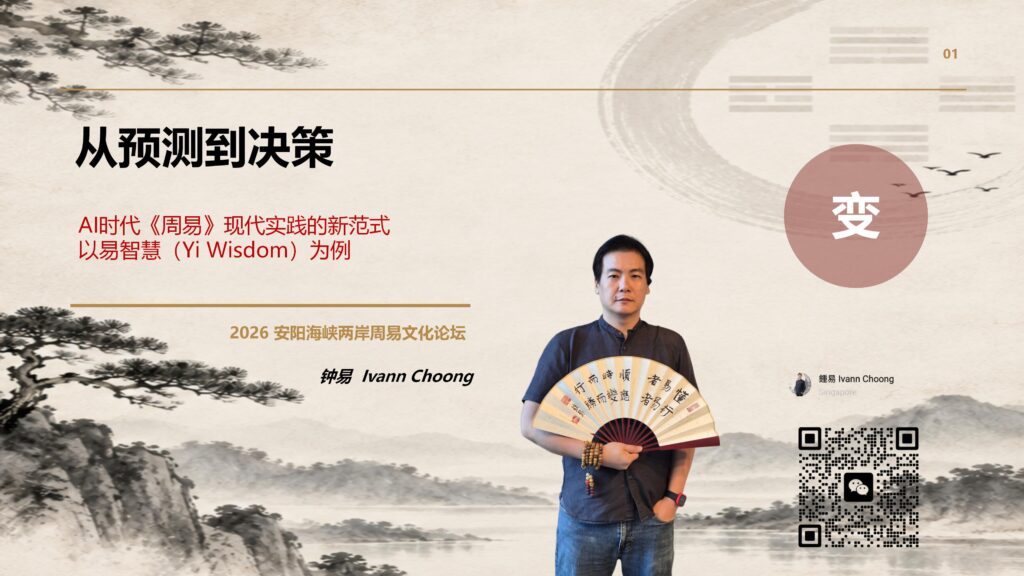
从预测到决策:AI时代《周易》现代实践的新范式 ——
以易智慧(Yi Wisdom)为例
From Prediction to Decision: A New Paradigm for the Modern Practice of Zhouyi in the AI Era — The Case of Yi Wisdom
- 作者 / Author : 钟易(Ivann Choong)
- 机构 / Affiliation : Founder, Yi Wisdom Culture
- 研究方向 / Research focus : Zhouyi · Yi Jing · Yi Wisdom · DUC · Decision-Making · Artificial Intelligence
- 会议背景 / Conference context : 2026 安阳海峡两岸周易文化论坛,安阳,2026 年 9 月 22 日
- 版本 / Edition : Yi Wisdom Culture 网站出版母稿 V2609
核心命题
AI 能够帮助人类更快地认识世界,《周易》帮助人类更深地理解变化,而
真正决定未来的,始终是人在变化中的选择。
读者导语
随着人工智能越来越擅长处理数据、识别模式并预测可能结果,一个更根本的问题随之凸显:当多个选择都具备合理依据时,究竟应当如何决定行动?概率可以帮助人理解风险,却不能替代价值判断,也不能替人承担选择的责任。本文从这一决策困境出发,重新讨论《周易》在 AI 时代的现代意义。文章把《周易》理解为关于变化、关系与时机的经典思想资源,并将其与人工智能的数据能力相对照。作者提出易智慧(Yi Wisdom)及其 DUC 实践框架,即 Discover(掘)、Understand(解)与 Control(握),用以说明个人与组织如何从发现真实情境、理解关系和变化,进一步形成行动并持续修正。DUC 不是新的占卜方法,也不是预测技术。全文进一步以 Data、Pattern、Decision 三个层次说明 AI、《周易》与人的判断如何互补,并讨论其在企业管理、个人发展、组织治理和《周易》教育中的可能应用。
中文摘要
人工智能提升了资讯处理、模式识别与趋势预测能力,但现实决策仍涉及价值、时机、关系、情境与责任,无法完全由概率模型取代。本文从 AI 时代的决策困境出发,重新审视《周易》的现代价值,主张其意义不应局限于预测未来,也可理解为观察变化、把握时机与提升决策品质的思想资源。文章以易智慧(Yi Wisdom)为实践案例,提出掘、解、握(Discover–Understand–Control,DUC)框架:先发掘真实情境,再理解关系、原因与变化,继而辨识可采取的行动并持续修正。DUC 是依据《周易》变化思想整理的现代实践框架,并非新的占卜方法或预测技术。本文进一步提出 Data–Pattern–Decision(DPD)三层模型,并将 AI 的数据智能,《周易》的变化与规律思维,以及易智慧的决策实践置于互补关系中,讨论其在企业管理、个人发展、组织治理、教育及 AI 辅助易学研究中的应用可能。
关键词:周易;易智慧;人工智能;决策智慧;DUC;变化;现代实践
Reader Introduction
As artificial intelligence becomes increasingly capable of processing information, identifying patterns and estimating possible outcomes, a more difficult question comes into view: when several options appear reasonable, who decides what should actually be done? Probability can clarify risk, but it cannot replace value judgement or assume responsibility for action. This paper approaches that problem by reconsidering the modern relevance of Zhouyi in the AI era. It treats Zhouyi as a foundational source of thought about change, relationships and timing, while distinguishing it from specialised practices such as BaZi, divination and Feng Shui. The paper introduces Yi Wisdom and its DUC practical framework: Discover, Understand and Control. DUC describes a process of identifying the real situation, understanding the relationships and changes at work, choosing actions within one’s sphere of influence, and continuing to adjust. It is not a new divination method or prediction technique. The paper also develops a complementary model in which AI contributes Data Intelligence, Zhouyi contributes a perspective on patterns and change, and Yi Wisdom supports Decision Wisdom. The central argument is that stronger prediction does not remove the need for human judgement. It makes careful decisions, ethical responsibility and adaptive action more important.
English Abstract
Artificial intelligence has strengthened information processing, pattern recognition and the prediction of possible outcomes. Yet consequential decisions still involve values, timing, relationships, context, judgement and responsibility, none of which can be fully replaced by probability models. Beginning with this decision-making challenge, this paper reconsiders the modern relevance of Zhouyi. It argues that Zhouyi should not be confined to the prediction of future events, but may also be understood as an intellectual resource for observing change, recognising timing and improving decision quality. Using Yi Wisdom as a practical case, the paper presents the DUC framework: Discover, Understand and Control. Discover identifies the real situation and emerging patterns; Understand examines relationships, causes and changes; Control identifies what can be acted upon, selects actions and continues to adjust. DUC is a modern practical framework based on the change-oriented thinking of Zhouyi. It is neither a new divination method nor a prediction technique. The paper further introduces a Data–Pattern–Decision model and describes a complementary relationship among AI’s Data Intelligence, Zhouyi’s perspective on patterns and change, and Yi Wisdom’s Decision Wisdom. Possible applications are considered in enterprise management, personal development, organisational governance, education and AI-assisted Yi studies. The paper concludes that improved prediction cannot replace human responsibility for judgement and action.
Keywords: Zhouyi; Yi Wisdom; Artificial Intelligence; Decision-Making; DUC; Change; Modern Practice
读者导语
随着人工智能越来越擅长处理数据、识别模式并预测可能结果,一个更根本的问题随之凸显:当多个选择都具备合理依据时,究竟应当如何决定行动?概率可以帮助人理解风险,却不能替代价值判断,也不能替人承担选择的责任。本文从这一决策困境出发,重新讨论《周易》在 AI 时代的现代意义。文章把《周易》理解为关于变化、关系与时机的经典思想资源,并将其与人工智能的数据能力相对照。作者提出易智慧(Yi Wisdom)及其 DUC 实践框架,即 Discover(掘)、Understand(解)与 Control(握),用以说明个人与组织如何从发现真实情境、理解关系和变化,进一步形成行动并持续修正。DUC 不是新的占卜方法,也不是预测技术。全文进一步以 Data、Pattern、Decision 三个层次说明 AI、《周易》与人的判断如何互补,并讨论其在企业管理、个人发展、组织治理和《周易》教育中的可能应用。
Reader Introduction
As artificial intelligence becomes increasingly capable of processing information, identifying patterns and estimating possible outcomes, a more difficult question comes into view: when several options appear reasonable, who decides what should actually be done? Probability can clarify risk, but it cannot replace value judgement or assume responsibility for action. This paper approaches that problem by reconsidering the modern relevance of Zhouyi in the AI era. It treats Zhouyi as a foundational source of thought about change, relationships and timing, while distinguishing it from specialised practices such as BaZi, divination and Feng Shui. The paper introduces Yi Wisdom and its DUC practical framework: Discover, Understand and Control. DUC describes a process of identifying the real situation, understanding the relationships and changes at work, choosing actions within one’s sphere of influence, and continuing to adjust. It is not a new divination method or prediction technique. The paper also develops a complementary model in which AI contributes Data Intelligence, Zhouyi contributes a perspective on patterns and change, and Yi Wisdom supports Decision Wisdom. The central argument is that stronger prediction does not remove the need for human judgement. It makes careful decisions, ethical responsibility and adaptive action more important.
中文摘要
人工智能提升了资讯处理、模式识别与趋势预测能力,但现实决策仍涉及价值、时机、关系、情境与责任,无法完全由概率模型取代。本文从 AI 时代的决策困境出发,重新审视《周易》的现代价值,主张其意义不应局限于预测未来,也可理解为观察变化、把握时机与提升决策品质的思想资源。文章以易智慧(Yi Wisdom)为实践案例,提出掘、解、握(Discover–Understand–Control,DUC)框架:先发掘真实情境,再理解关系、原因与变化,继而辨识可采取的行动并持续修正。DUC 是依据《周易》变化思想整理的现代实践框架,并非新的占卜方法或预测技术。本文进一步提出 Data–Pattern–Decision(DPD)三层模型,并将 AI 的数据智能,《周易》的变化与规律思维,以及易智慧的决策实践置于互补关系中,讨论其在企业管理、个人发展、组织治理、教育及 AI 辅助易学研究中的应用可能。
关键词:周易;易智慧;人工智能;决策智慧;DUC;变化;现代实践
English Abstract
Artificial intelligence has strengthened information processing, pattern recognition and the prediction of possible outcomes. Yet consequential decisions still involve values, timing, relationships, context, judgement and responsibility, none of which can be fully replaced by probability models. Beginning with this decision-making challenge, this paper reconsiders the modern relevance of Zhouyi. It argues that Zhouyi should not be confined to the prediction of future events, but may also be understood as an intellectual resource for observing change, recognising timing and improving decision quality. Using Yi Wisdom as a practical case, the paper presents the DUC framework: Discover, Understand and Control. Discover identifies the real situation and emerging patterns; Understand examines relationships, causes and changes; Control identifies what can be acted upon, selects actions and continues to adjust. DUC is a modern practical framework based on the change-oriented thinking of Zhouyi. It is neither a new divination method nor a prediction technique. The paper further introduces a Data–Pattern–Decision model and describes a complementary relationship among AI’s Data Intelligence, Zhouyi’s perspective on patterns and change, and Yi Wisdom’s Decision Wisdom. Possible applications are considered in enterprise management, personal development, organisational governance, education and AI-assisted Yi studies. The paper concludes that improved prediction cannot replace human responsibility for judgement and action.
Keywords: Zhouyi; Yi Wisdom; Artificial Intelligence; Decision-Making; DUC; Change; Modern Practice