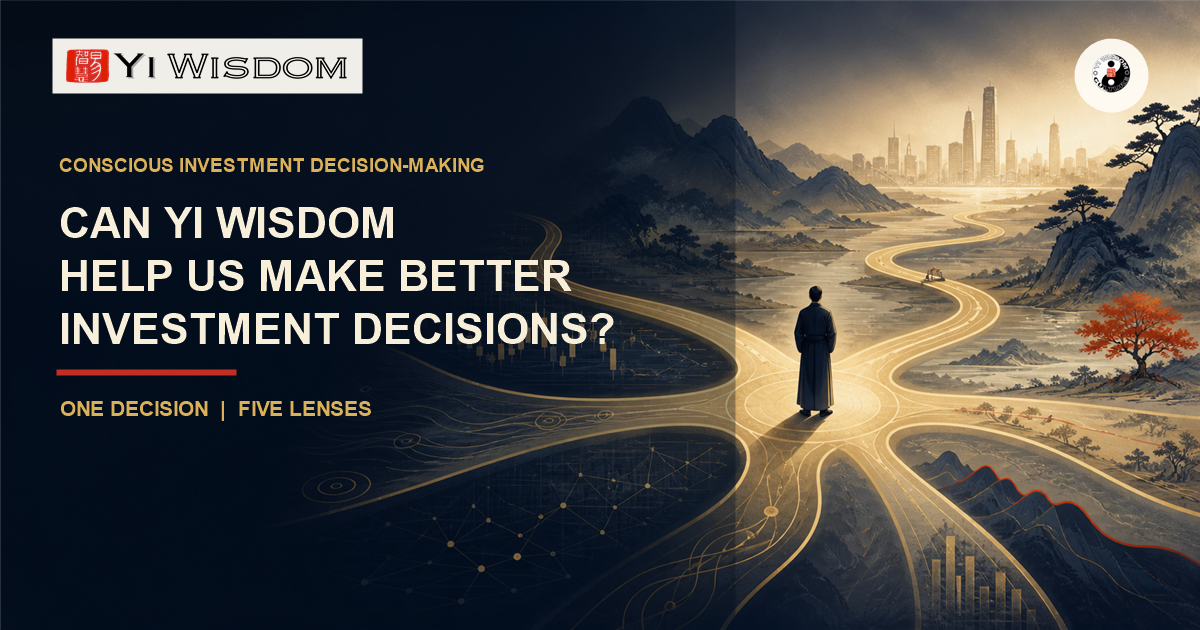
Can Yi Wisdom Help Us Make Better Investment Decisions?

Investment decisions are rarely based on numbers alone.
We may study financial reports, examine price charts, follow economic news and listen to market analysts. Yet when it is time to act, other questions often arise:
- Is this opportunity suitable for me?
- Is this the right time to act?
- How might the situation develop?
- How much capital should I commit?
- Am I making a considered decision—or reacting emotionally?
These questions led me to explore how Yi Wisdom could contribute to investment decision-making.
The purpose is not to replace conventional investment analysis or predict the market with certainty. It is to develop a more complete and conscious decision process.
Investment Information Is Only the Beginning
Conventional investment analysis helps us understand an opportunity.
Fundamental analysis examines the underlying value of an asset. Technical analysis studies price behaviour and market momentum. News and economic information provide the wider context.
Together, they help answer an important question:
What are we considering?
But even when two people are looking at the same investment, they may not make the same decision. Their financial position, temperament, timing, risk tolerance and personal circumstances may be very different.
Knowing what is happening in the market does not automatically tell us what we should do.
That is where the Yi Wisdom Investment Decision Framework offers another perspective.
One Decision, Five Different Lenses
The framework examines an investment decision through five connected lenses.
1. WHAT — Conventional Analysis
The process begins with the investment itself.
What is the asset? What are its fundamentals? What is the market indicating? What risks and opportunities can be identified through conventional research?
Yi Wisdom should not be used as a substitute for proper analysis. An investment must first make sense on its own merits.
2. WHEN — BaZi Timing
BaZi introduces the relationship between the person and the timing of the decision.
For example, a particular date may represent a Wealth Day for one individual but interact differently with another person’s natal chart.
This does not mean that a Wealth Day guarantees a profitable investment. Instead, BaZi provides a personal timing perspective:
- Is the timing supportive of wealth-related action?
- Does it suggest action, caution or observation?
- How does the date interact with the individual?
The emphasis is on personal alignment—not market prediction.
3. HOW — Divination
Divination explores how a particular situation may develop.
Rather than asking a vague question such as “Will this investment make money?”, we can examine a clearly defined decision and consider:
- The present condition
- The likely development of the situation
- Emerging opportunities or risks
- Possible turning points
- Potential selling or exit timing
Divination does not remove uncertainty. Its role is to reveal another perspective that may help the investor consider circumstances they have overlooked.
4. HOW MUCH — Risk Management
Even a well-considered opportunity can produce an unfavourable outcome.
That is why position sizing and risk management remain essential.
Before acting, an investor should consider:
- How much can I afford to lose?
- How concentrated will my position become?
- What would cause me to reduce or exit the investment?
- Am I acting according to a plan or because of excitement and fear?
- What happens if my interpretation is wrong?
Yi Wisdom can inform a decision, but it cannot protect someone who ignores financial discipline.
5. WHO DECIDES — The Human
The final decision always belongs to the individual.
Neither BaZi nor divination should become a way to avoid responsibility. The purpose of the framework is not to surrender our judgment to a system.
It is to help us pause, examine the decision from several angles and act more consciously.
A Good Outcome Is Not Always a Good Decision
One of the most important lessons in investing is the difference between decision quality and outcome quality.
A careless decision may still make money because the market moved favourably. A disciplined decision may experience a temporary loss because the market is uncertain.
If we judge every decision only by its immediate result, we may reward poor habits and abandon sound ones.
A better review asks:
- What information was available when I decided?
- Did I follow a considered process?
- Did I understand the risks?
- Was my position size appropriate?
- What did I overlook?
- What can I improve next time?
The objective is not to make every investment profitable. That is unrealistic.
The objective is to become a more aware and disciplined decision-maker.
Is This the Right Next Step for You?
The market will always contain uncertainty.
We cannot control every price movement, headline or unexpected event. But we can improve the process through which we respond.
If you are interested in exploring how conventional analysis, BaZi, divination, risk management and personal judgment can work together, you are welcome to contact me for a conversation about the pilot cohort.
The goal is not to predict every market outcome.
It is to make each decision with greater awareness.
Written by Ivann Choong (锺易)
Founder, Yi Wisdom Culture
Yi Jing Educator & Yi Wisdom Methodology Practitioner