Yi Wisdom BaZi: From Reading Destiny to Understanding Decisions
BaZi (八字), also known as the Four Pillars of Destiny (四柱八字), has traditionally been used to understand patterns associated with a person’s date and time of birth.
Through the relationships between the Heavenly Stems, Earthly Branches, Five Elements, Day Master and changing cycles, BaZi provides a structured way to examine different aspects of a person’s life.
At Yi Wisdom Culture, we continue to respect and use these traditional foundations.
But we ask one additional question:
“Once we understand the patterns in a BaZi chart, what do we do with that understanding?“
This is where Yi Wisdom BaZi begins.
Traditional BaZi Provides the Foundation
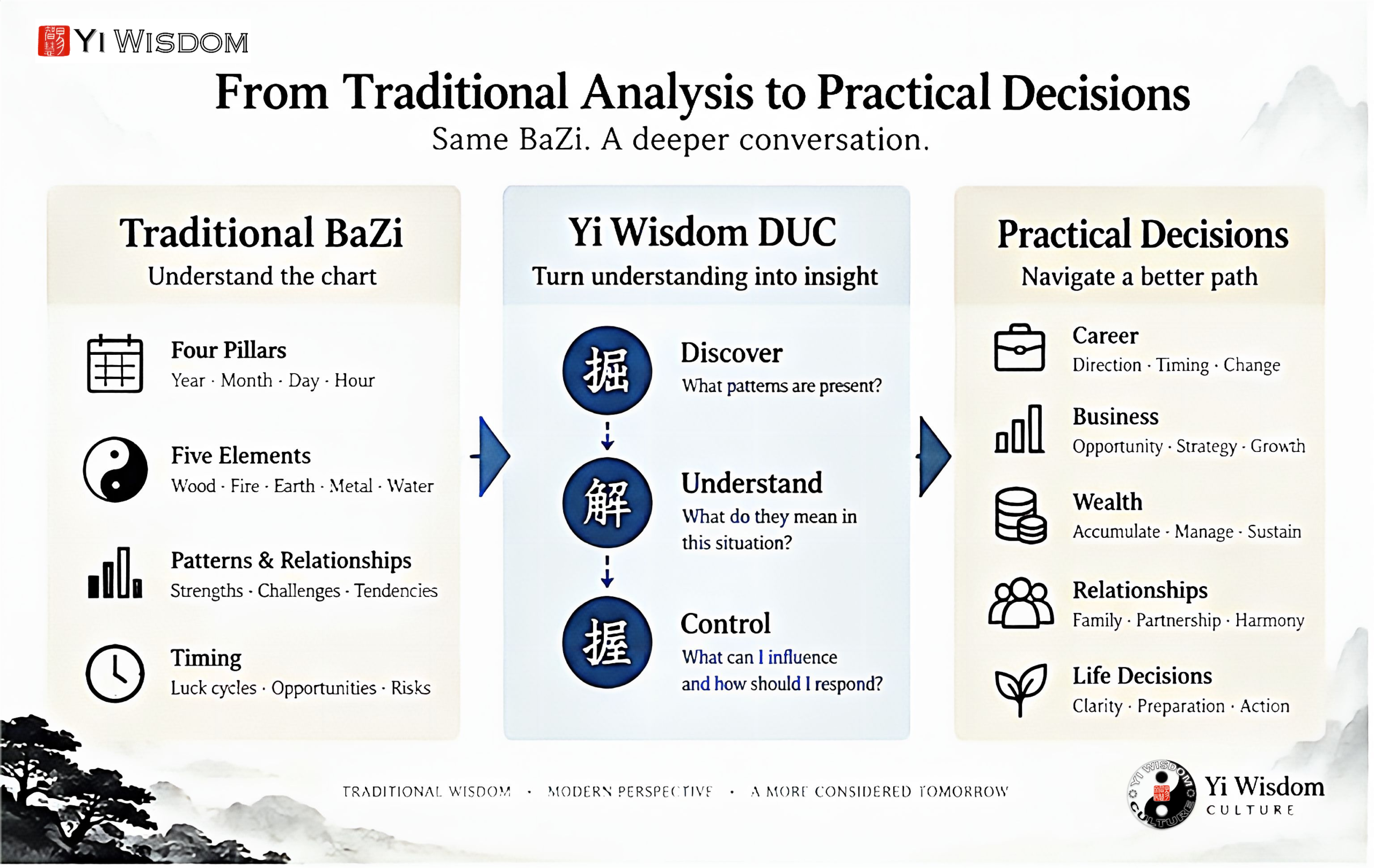
Traditional BaZi gives us a framework for examining patterns.
A reading may help us explore areas such as personality, strengths and weaknesses, career, relationships, wealth and timing.
This knowledge is valuable.
However, knowing a pattern does not automatically tell us what decision to make.
For example, a BaZi analysis may indicate entrepreneurial tendencies or a period where opportunities for change become more prominent.
Does that automatically mean someone should resign from their job and start a business?
Not necessarily.
The person’s experience, financial position, responsibilities, business idea, market conditions and risk tolerance also matter.
The BaZi chart gives us information.
The circumstances give that information context.
From Prediction to Understanding
People often approach BaZi with questions such as:
Will I become wealthy?
Will my business succeed?
Is this a good year for me?
Should I change my career?
Yi Wisdom does not dismiss these questions. Instead, we take them further.
Rather than asking only:
“What will happen?”
we also ask:
“What patterns are present, what do they mean in my current circumstances, and what can I do about them?”
This shifts BaZi from being purely about prediction towards understanding and decision awareness.
A pattern may indicate a tendency or changing condition.
It does not mean every person experiencing that pattern will produce the same outcome.
People respond differently.
And those responses matter.
Introducing the Yi Wisdom DUC Methodology
Yi Wisdom applies a simple framework:
Discover 掘 → Understand 解 → Control 握
Discover the patterns and information that are present.
Understand what those patterns mean within the actual circumstances.
Control what can realistically be influenced through decisions and actions.
BaZi therefore becomes one part of a larger thinking process.
We are not simply asking:
“What does my BaZi say?”
We are asking:
“What can I do with what I now understand?”
This is the foundation of Yi Wisdom BaZi.
BaZi Is One Tool Within Yi Wisdom
Yi Wisdom is broader than BaZi.
Yi Jing (易经) provides foundational principles for understanding change, relationships and transformation.
BaZi (八字) helps us examine personal patterns and changing cycles.
Divination (占卜) can help examine a specific question or situation.
Feng Shui (风水) examines relationships between people, space and environment.
These systems have different functions and should not be treated as interchangeable.
Yi Wisdom provides a framework for bringing these perspectives into practical situations.
From Knowing to Applying
Understanding your BaZi can help you recognise patterns.
But recognition is only the beginning.
The more important question is:
“Now that I understand this pattern, how should I respond?“
That is the transition from traditional analysis into Yi Wisdom application.
Traditional BaZi provides the foundation.
Yi Wisdom BaZi takes the next step — from reading destiny towards understanding decisions.
Continue the Series
Next: From BaZi to DUC: Discover, Understand and Control Your Decisions
We will explore how the three stages of DUC can be applied to an actual BaZi question.
About the Author:
Ivann Choong (锺易) is the founder of Yi Wisdom Culture and creator of the Yi Wisdom DUC Methodology — Discover, Understand and Control. His work focuses on bringing the principles of Yi Jing into modern life through BaZi, Divination and Feng Shui, helping individuals and businesses understand patterns, navigate change and make more considered decisions.